
Table of Contents
ToggleTwo tiny homes connected by a breezeway represent one of the smartest housing innovations gaining traction among homeowners and investors. This layout combines the efficiency of compact living with the flexibility of dual units, making it ideal for multi-generational families, rental income opportunities, or simply maximizing limited land. The breezeway, that open-air or semi-enclosed passage linking the homes, isn’t just a charming architectural detail: it’s a practical solution that maintains privacy while fostering connection. Whether you’re considering this setup for personal use or resale value, understanding the design, construction, and zoning requirements will set you up for success.
Key Takeaways
- Two tiny homes connected by a breezeway maximize land efficiency and rental income potential while maintaining privacy between dual units on a single lot.
- A well-designed breezeway typically measures 8 to 12 feet wide and 20 to 30 feet long, with proper spacing, orientation, and sight-line planning to balance connectivity and privacy.
- Each unit must have its own foundation, HVAC system, water heater, and electrical panel to prevent settling issues and avoid billing disputes between residents.
- Zoning approval is critical before construction—most jurisdictions require properties with two homes to be zoned for duplex, multi-family, or accessory dwelling unit (ADU) use, not standard single-family.
- Intentional interior and exterior design, including matching finishes, open-plan layouts, and a thoughtfully furnished breezeway, prevents the property from appearing disjointed and enhances both livability and resale appeal.
Why Tiny Homes Connected By Breezeways Are the Next Big Trend
Demand for flexible housing keeps climbing, and the dual-unit breezeway configuration answers multiple needs at once. Homeowners value the ability to generate rental income, house aging parents or adult children, or maintain separate guest quarters without committing to sprawling square footage. Rising land costs and stricter zoning in suburban areas make maximum usability per acre a real economic driver.
The breezeway itself, whether open air or partially enclosed, strikes a balance that appeals to builders and residents alike. Unlike a full connecting hallway, it doesn’t count toward combined square footage in many jurisdictions, keeping each unit below size thresholds that trigger different permitting or zoning restrictions. This nuance can mean the difference between a straightforward approval and a lengthy variance process.
Architecturally, the design draws inspiration from vernacular traditions. The Texas dogtrot, a time-tested style featuring two structures joined by an open passage, proves that climate, privacy, and connectivity can coexist elegantly. Modern interpretations blend this heritage with contemporary materials and energy efficiency, creating spaces that photograph well enough to become investment assets themselves. Articles on Curbed frequently highlight breezeway designs as a growing trend in affordable, adaptable housing solutions.
Designing the Perfect Breezeway Layout
A breezeway’s effectiveness depends on thoughtful spatial planning and understanding how movement flows between units. The passage connects two separate homes while creating a visual and functional break that defines each space.
Space Planning and Dimensions
Most residential breezeways run 8 to 12 feet wide and 20 to 30 feet long, though local building codes and site constraints will dictate specifics. Width matters for functionality: narrower than 6 feet feels cramped and blocks movement when both residents need to pass: wider than 14 feet becomes wasted conditioned space if enclosed. Orientation is equally critical, a north-facing breezeway in cold climates should lean toward partial or full enclosure to avoid wind tunneling, while southern exposures can remain open or use shade structures to manage sun.
Entry points from the breezeway into each unit should feel intentional, not an afterthought. Plan for standard 3-foot single doors or wider openings if wheelchair accessibility is a requirement. Position them recessed slightly from the breezeway edge so rain doesn’t pool at the threshold. Utility lines (water, electric, gas) often run beneath or alongside the breezeway, so coordinate placement early with your mechanical contractor to avoid expensive rerouting during framing.
Consider sight lines and privacy. If windows from one unit overlook the breezeway into the neighboring home, address it with strategic landscaping, frosted glass panels, or privacy fencing. Neighbors living 20 feet apart need visual separation even when traffic patterns overlap. Many successful layouts angle the two structures slightly, 5 to 15 degrees, so direct sightlines don’t occur at all. This also strengthens the design’s visual appeal from the street.
Practical Benefits of a Breezeway Connection
The dual-unit breezeway model unlocks opportunities that traditional single-family homes or detached properties can’t match.
Rental and Income Potential: Owner-occupants often rent one unit, covering or exceeding mortgage payments. Zoning permitting two separate dwelling units opens rental legality that might be restricted elsewhere. Income stability makes financing easier and improves property ROI.
Flexible Multigenerational Living: Aging parents or adult children gain independence while staying on-site. The breezeway provides buffer space, nobody feels crowded, and each household maintains its own entrance, utilities, and privacy. This arrangement often costs far less than assisted living or second properties.
Land Efficiency: Two homes on a standard lot (typically 0.25 to 0.5 acres) maximize density without requiring major subdivision, which saves surveying costs and avoids additional title complications. A single breezeway structure uses minimal additional footprint compared to building two entirely separate homes.
Utility Sharing and Cost Savings: While each unit needs its own meter for separate billing, shared infrastructure like foundation work, roof framing over the breezeway, and sometimes driveway access reduces overall construction expense. Some jurisdictions allow shared septic systems for dual units, though this varies, check local codes early.
Resale and Adaptability: Buyers appreciate dual-unit properties, especially in markets where affordability is tight. If circumstances change, the configuration allows selling as a single investment property, splitting units into separate parcels (if zoning permits), or converting one unit to a dedicated workspace, studio, or guest house. Flexibility appeals to investors and owner-occupants alike. Resources like Tiny House Plans for a Stylish, Sustainable Lifestyle explore layouts tailored to multi-use scenarios.
Building and Construction Considerations
Building two connected units requires more planning than a single home, you’re essentially managing two projects that share walls, utilities, and land.
Foundation and Structural Layout: Tiny homes often sit on permanent foundations (concrete slab, pier and beam, or full basement) rather than crawl spaces, which saves cost and complexity. Each unit needs its own footing and structural support: the breezeway typically uses separate posts or a frame system that doesn’t tie the buildings together structurally. This separation prevents one unit’s settling from stressing the other. Nominal lumber dimensions matter: 2×6 studs and joists are standard for tiny home framing, though span tables will confirm whether 2×8s are needed based on your local snow load and roof pitch.
Framing and Weatherproofing: Establish a consistent building envelope. Both units should use the same R-value insulation (R-19 to R-21 in walls, R-38 to R-49 in roofs depending on climate zone) and compatible exterior finishes so the property reads as intentional design, not patchwork. The breezeway’s framing, whether open-air lattice or partial enclosure, must tie back into each unit’s roof and wall structure with proper flashing and air sealing to prevent water infiltration.
Mechanical Systems: Each unit needs its own HVAC system, water heater, and electrical panel. Shared systems seem economical upfront but create liability headaches and billing disputes. Ductwork and supply lines should be routed away from the breezeway to avoid freezing in cold climates. If the breezeway is partially enclosed or roofed, insulate and condition it to prevent temperature swings that degrade adjacent spaces. Coordinate with your HVAC contractor early so duct runs don’t force awkward framing changes.
Structural Integrity and Local Codes
Building codes vary dramatically by location, and many jurisdictions haven’t fully updated their standards for dual-unit tiny home configurations. Before breaking ground, secure written approval of your exact design.
Zoning and Permitting: Most areas define a “single-family residence” as one dwelling unit per lot. Two units typically require the property to be zoned for “duplex,” “multi-family,” or “accessory dwelling unit (ADU)” use. ADU rules often have strict limitations: one unit must be owner-occupied, size caps of 750 to 900 square feet, or setback requirements that affect lot layout. Violating zoning isn’t a quick fix, it can tank resale and invite costly enforcement.
Structural Standards: The International Residential Code (IRC) applies to most single-family and duplex construction nationwide, but amendments vary. Load paths, snow loads, seismic design, and wind resistance all depend on your location. A structural engineer should certify your design, especially if you’re pushing size or material innovations. This costs $800–$2,000 upfront but prevents costly redesigns after permitting.
Setbacks and Separation: Fire and life-safety codes require minimum spacing between combustible structures, typically 5 to 10 feet. The breezeway’s roof and walls must meet fire-rating standards if they’re enclosed. Open-air breezeways sidestep this, which is one reason they remain popular. Building departments will specify which walls need 1-hour or 2-hour fire rating, influencing your material choices (drywall, mineral wool, or other rated assemblies).
Permits and Inspections: Budget for inspections at foundation, framing, mechanical (rough-in), and final stages. Hiring a builder familiar with dual-unit projects reduces surprises: unfamiliar inspectors sometimes request changes mid-project. Getting written approval of plans before permits saves time and money. A comprehensive Tiny Home Construction Timeline helps you anticipate permitting stages and sequencing.
Interior Design and Flow Between Units
Two tiny homes demand thoughtful interior design to feel spacious and cohesive even though their size.
Unit Independence: Each home should have a distinct entry and its own kitchen and bathroom, non-negotiable for privacy and function. Open-plan living in each unit makes compact square footage feel larger: avoid dividing 400 square feet into separate rooms unless you’re housing multiple adults. High ceilings, clerestory windows, and light colors stretch perception without adding cost.
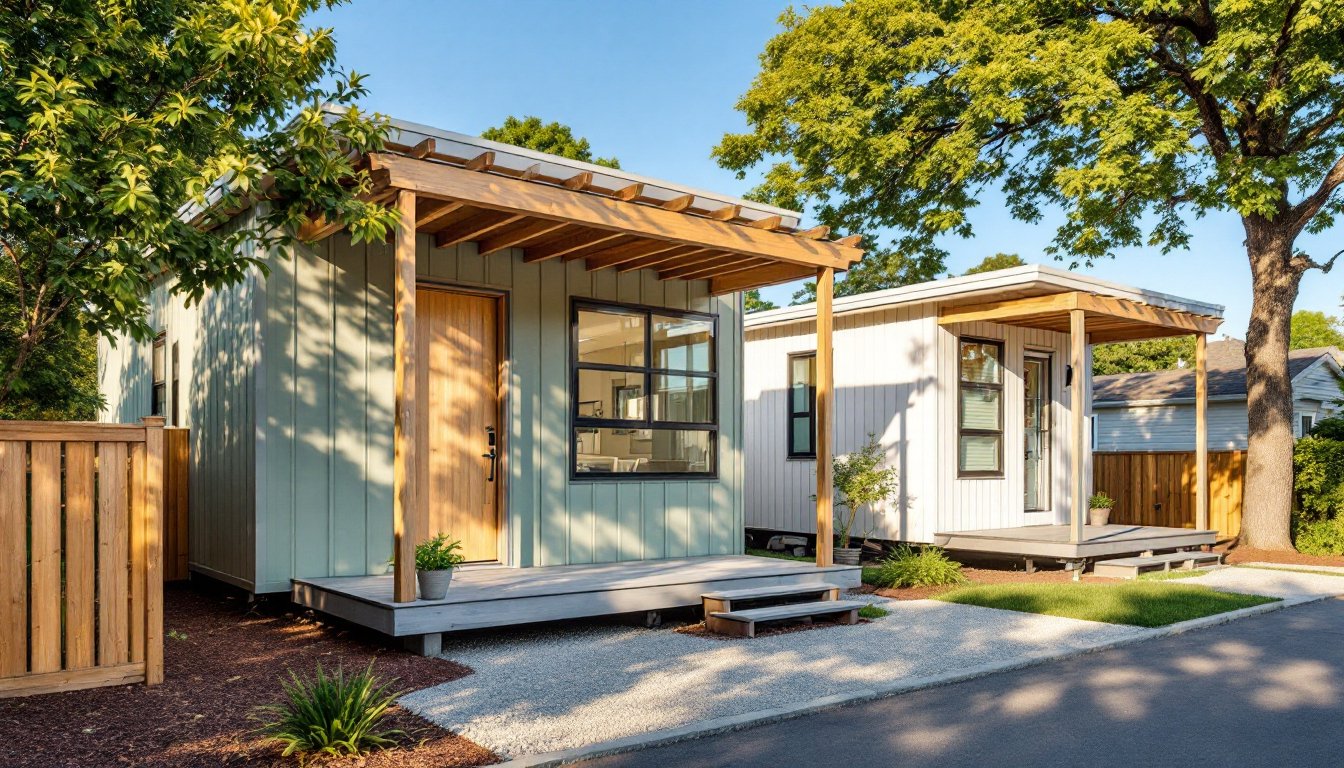
Breezeway as Circulation: The breezeway becomes outdoor living space when designed intentionally. Overhead shade structures (pergolas, retractable awnings) and durable flooring (composite decking, concrete with non-slip coating) transform it into a transition zone, part of the landscape, not a dead hallway. Furnish it minimally: a bench, potted plants, and lighting for evening function. This addition barely impacts construction cost but significantly improves livability.
Color and Material Continuity: Using the same exterior finish and trim on both units prevents the property from looking like two afterthoughts. Interior color palettes needn’t match unit-to-unit, but consistency in flooring material or ceiling height keeps the overall design coherent. Practical finishes matter in tiny homes, luxury vinyl planks (LVP) and laminate outperform solid wood in moisture-prone climates and are easier to maintain in high-traffic areas like breezeways.
Utility Routing and Visibility: Exposed ductwork, pipes, and wiring work in industrial-aesthetic tiny homes but require intentional design to avoid looking unfinished. Concrete soffits or stained wood paneling can integrate mechanical systems visually. The same applies to the breezeway: leave it raw and authentic, or dress it with finishes that complement the homes. Articles on Tiny House Style Guide detail how to blend compact living with design intent.
Outdoor Connection: Each unit should have a small patio or porch, not luxury, but functional connection to the landscape. A 6-foot by 8-foot slab costs under $1,000 and adds perceived space. Landscaping between the homes and the breezeway frames views and creates privacy naturally, turning tight site planning into an asset.
Design inspiration can come from professional sources: platforms like Homify showcase thousands of compact home layouts, many featuring breezeway or semi-detached configurations. Seeing how others solved spatial and aesthetic challenges accelerates your own planning.